
Georgia Corrections Release Path
Forsyth County felony defendants sentenced to state prison can move from the county jail into GDC custody. That transfer ends the county jail stay but does not release the person to the community. From that point, GDC tracks the institution, sentence computation, current status, maximum possible release date, actual release date, and incarceration history. The statewide record is therefore the main source for a later state-prison release.
A person can leave a GDC institution at sentence end, on parole, or under another lawful release order. An actual release date is the strongest public GDC field for confirming departure from state custody. A maximum possible release date is different. It reflects sentence computation and may change under lawful credits, sentence structure, court orders, or other events. A Tentative Parole Month from the Parole Board is also not a final release order.
Search Georgia Corrections Records
Use the GDC offender query for both active and inactive records. Active generally covers a person still active in the department's public system. Inactive is the important scope for a person who has been released or discharged. A county-jail detainee who never entered state prison may have no GDC record, even if the Forsyth County Jail once held that person.
- Choose inactive offenders, or both active and inactive, when checking a past state-prison release.
- Search by GDC ID when known. Otherwise use last and first name, case number, or the available physical fields.
- Use conviction county to narrow a Forsyth County sentence, but do not treat that filter as the current facility location.
- Open the matching result and compare GDC ID, major offense, sentence rows, and incarceration history.
- Read Actual Release Date for a completed custody event, then check parole sources if supervision may continue.
GDC advises users to verify public query information through written correspondence with its Inmate Records and Information office. That caution matters when names are similar, a sentence has changed, or a public result does not answer the exact release question.
Georgia Release Record Fields
The detailed offender result brings several state records together. No single field should be read in isolation. Identity fields confirm the match, sentence rows explain the legal terms, and incarceration history shows movement through the state system.
| GDC field | Meaning |
|---|---|
| Current status | Shows whether the record is active or inactive in the public system. |
| Actual release date | Confirms the recorded date the person left GDC custody. |
| Max possible release date | Shows the computed sentence-end date, not a guaranteed parole date. |
| Most recent institution | Identifies the latest GDC facility tied to the record. |
| Sentence and case rows | List offense, conviction county, sentence length, and case number. |
| Incarceration history | Provides state custody dates and prior GDC episodes. |
A photo and physical description may also appear. Known aliases and the GDC ID help avoid a false match. The detailed result can show a Forsyth conviction even when the person served time elsewhere in Georgia, since conviction county and prison location answer different questions.
Georgia Corrections Records Contact
GDC headquarters is a systemwide contact, not a prison in Forsyth County. The city of Forsyth, Georgia, is also separate from Forsyth County. The headquarters address should not be mistaken for the place where a Forsyth County prisoner was held. Use the offender detail for the most recent institution and the department contact for statewide questions.
Georgia Department of Corrections
Headquarters: 300 Patrol Road, Forsyth, GA 31029
Inmate Concerns / Questions: 404-656-4661
Offender query: Find an Offender
Records: GDC open-records request
A focused records request should state the person's name, GDC ID if known, case number, conviction county, and date range. Ask for the state custody or discharge information needed, such as actual release date, institution history, or releasable sentence data. GDC says it gives an initial open-records response within three business days. Copying, search, and redaction costs may apply.
Georgia Parole Release Checks
Parole allows a person to serve part of a sentence in the community under conditions. The Georgia State Board of Pardons and Paroles decides parole matters, while the Georgia Department of Community Supervision handles field supervision. Those roles explain why a released GDC result may not answer whether the person remains under supervision.
Before release, the Board's Inmate TPM Lookup can show a Tentative Parole Month. A TPM is the month for final review and possible release planning, not a promise. It can change because of conduct, program completion, a revised decision, or required conditions. After release, the Board's parolee search can show parole begin and end dates and office information. DCS can then confirm the field office that handles supervision.
Cumming DCS Field Office
Address: 310 Tribble Gap Road, Cumming, GA 30040
Service area: Bell-Forsyth Circuit and Forsyth County
Hours: Monday through Friday, 8:00 a.m. to 4:30 p.m.
Probation may also follow a Forsyth County court sentence without a state-prison discharge. The court order and DCS office are the right sources for that path. More detail is available on the Forsyth County probation and parole page.
Georgia Release Date Rules
Georgia does not apply one simple 85 percent rule to every state prisoner. The result depends on the offense, sentence, parole eligibility, and lawful credits. O.C.G.A. 42-5-101 authorizes work incentive credits for eligible felony prison terms other than life imprisonment. GDC's Performance Incentive Credit program says eligible offenders may earn up to 12 points and potentially receive from one to 12 months off a TPM or maximum release date.
Not every person qualifies. GDC lists exclusions that include death sentences, life sentences, short sentences, non-parole-eligible or minimum-mandatory terms, and specified serious violent felony categories. O.C.G.A. 17-10-6.1 is critical for covered serious violent felony sentences. Certain term-of-years sentences must be served as imposed without parole or other sentence reduction. That is a 100 percent service rule for the covered sentence, not a broad rule for all Georgia cases.
- Actual release date
- The date GDC records departure from its custody.
- Maximum possible release date
- The computed sentence-end date after applicable sentence rules.
- TPM
- A tentative parole review month that can change before release.
- Discharge
- Completion of the custody or sentence term shown by the responsible agency.
Georgia Corrections Source Screens
The GDC questions about loved ones page directs readers to Find an Offender for facility, charge, and release information.
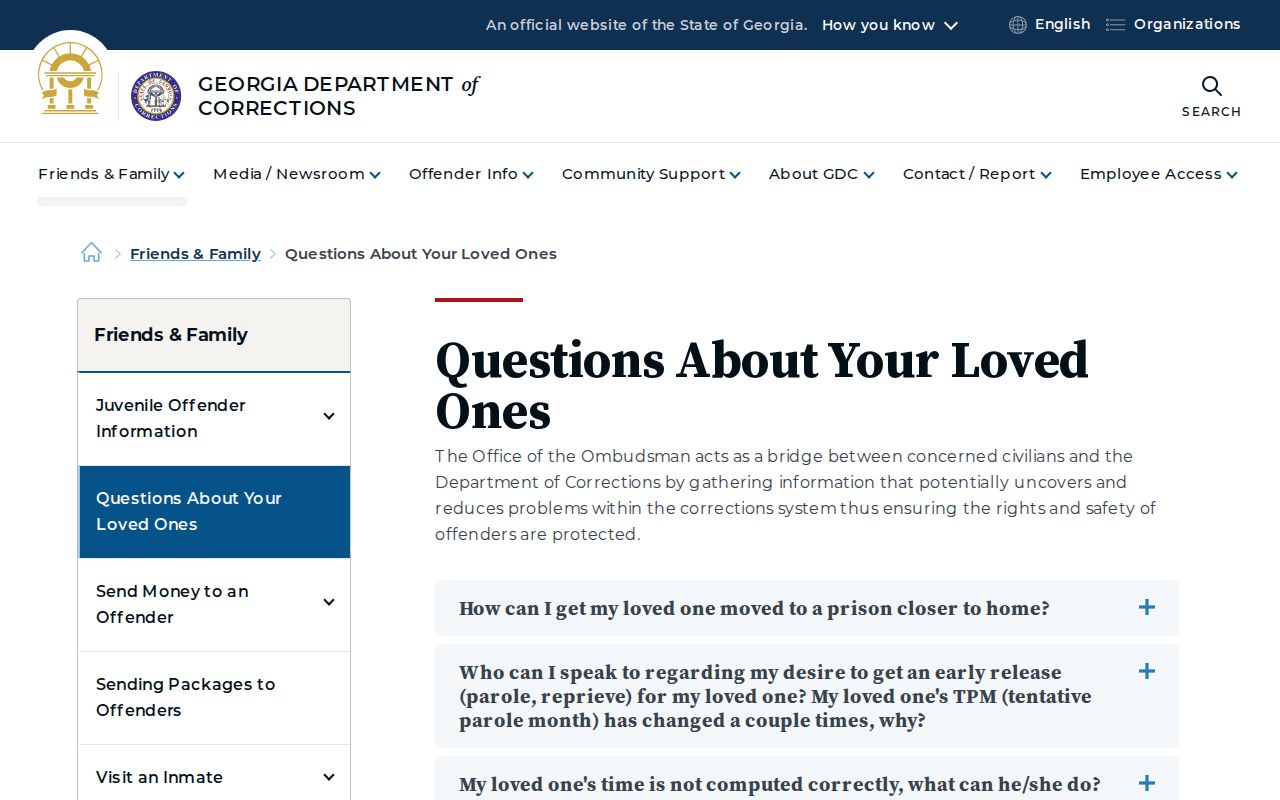
This official route reinforces that statewide custody questions belong with GDC after a Forsyth County jail transfer.
The GDC Forsyth headquarters listing confirms the department's central address and contact role.
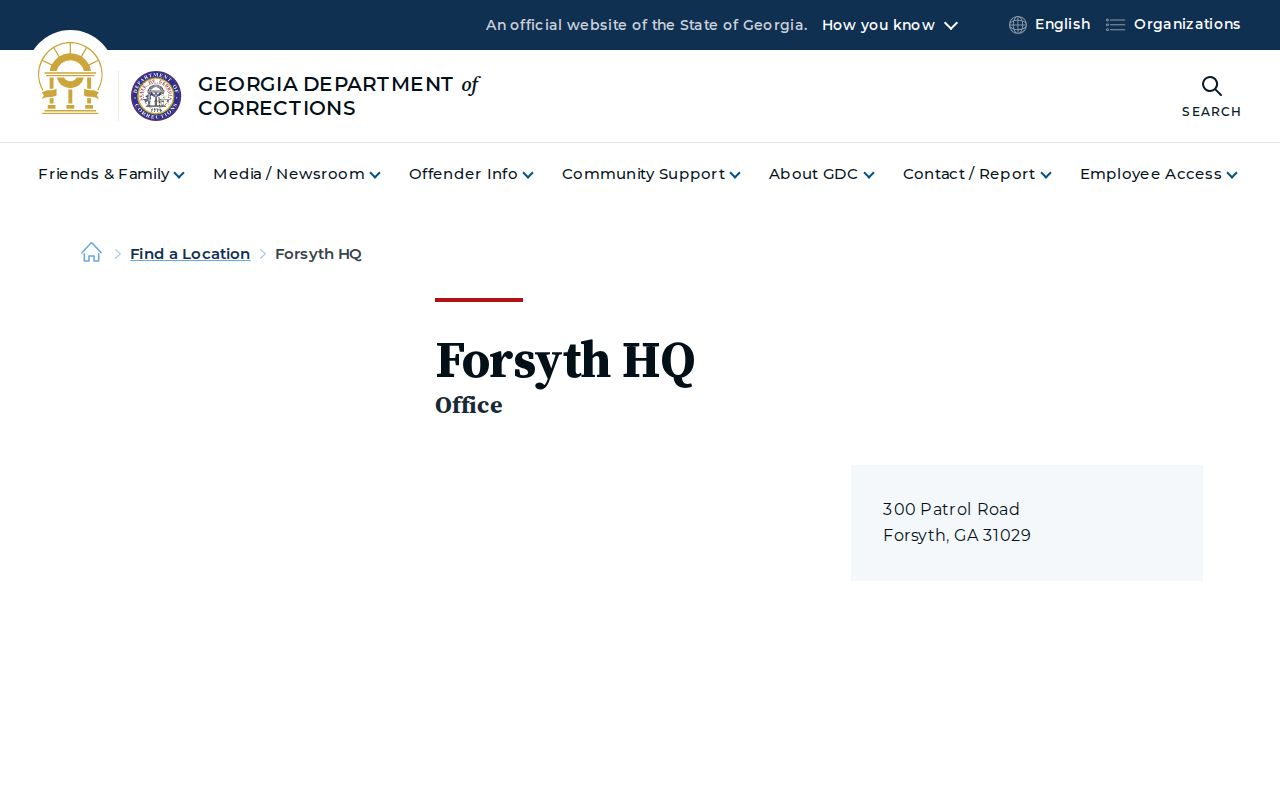
The city name on the headquarters record should not be confused with Forsyth County or with a prison location.
Forsyth State Release Follow-Up
A complete check often uses three records. The county jail record shows the local booking and transfer. GDC shows state custody and the actual release date. The Parole Board, DCS, and court order show what supervision or legal obligations continued after prison. If the person never entered GDC, return to the sheriff, clerk, or the agency that took custody.
VINELink can report a custody change when the agency feed contains the record, but it is not a full state sentence history. Likewise, an inactive GDC result does not explain every court event. The Forsyth County Clerk's case record may show the original judgment, later sentence modification, or probation order. Matching those sources yields a more accurate account than relying on one roster.
The court record is especially useful when the release outcome is tied to a sentence amendment, probation term, or later order. Forsyth's clerk routes Superior and State Court searches through re:SearchGA, which requires registration. The Superior Court Criminal Division keeps felony case files and lists 770-781-2120 option 5 for questions. Those files can clarify the sentence that sent a person into GDC and the orders that affected it.
State and county earned-time rules must also stay separate. O.C.G.A. 42-4-7 governs county jail records and earned-time allowances for a county sentence. GDC prison terms use the state sentence, eligible credits, parole rules, and offense-specific limits. A date calculated for a Forsyth County Jail sentence should not be substituted for the maximum possible release date on a GDC record.