
Forsyth Projected and Actual Release
A projected date estimates when custody should end under the facts then in the record. An actual release date confirms that the custody event occurred. Forsyth Sheriff's P2C can label its top-level field “Expected release” for a future date and “Released” when the date is past, but the county's settings hide the detailed release time and release reason.
Pretrial custody works differently. A person awaiting trial has not received a final jail or prison sentence to count down. Bond posting, a judge's order, dismissal, a plea, or a transfer may control when the person leaves the jail. A bond amount alone is not a release date because payment, processing, and other holds still matter.
A sentenced county inmate's term is computed by the Forsyth County Jail under the court order and county rules. A state prisoner is computed by GDC. The county jail does not set a GDC release date, and the GDC offender search is not the right source for every person who left the county jail.
Find a Forsyth Projected Release Date
Start with the agency now responsible for custody. A Forsyth conviction does not mean the person remains at the Forsyth County Jail. Felony prisoners can move into GDC, and federal or immigration transfers require other systems. Search with a full name and any official ID or case number available.
- Check Forsyth Sheriff's P2C Inmate Inquiry for a local jail record. Read whether the top-level date says expected release or released, and note that the exact time and reason are not public fields.
- Read the Forsyth court docket and sentencing order. The order identifies whether the person is pretrial, serving a county term, on probation, or committed to state custody.
- For a county sentence, ask the jail or Records Unit for the custody computation when the public card is incomplete. The Records Unit is reached through the sheriff's open-records process and JustFOIA portal.
- For state custody, use the GDC offender query. Search active and inactive records and compare the maximum possible release date, actual release date, current status, sentence rows, and conviction county.
- For possible parole, use the Board's TPM lookup. A TPM is a review month, so it must be reconciled with GDC and later parole records.
If the person was moved to BOP or ICE custody, county and GDC dates do not answer the final release question. Use the federal or immigration locator and the court docket. The Forsyth County release search maps those separate custody paths.
Forsyth Jail Earned-Time Computation
O.C.G.A. 42-4-7 governs county inmate records and earned time. It provides that a county inmate sentenced to confinement is released at the sentence's expiration less allowed earned-time deductions. It also addresses good-time allowances. The statute does not create a public calculator that can replace the jail's record.
A reliable county computation begins with the court sentence, credit for time already served, and the jail's applicable allowance record. Later court orders, bond changes, warrants, or a transfer can alter the path. Because Forsyth P2C hides detailed release reason and time fields, a person who needs the basis for the date should request the focused jail custody or release record.
County earned time should never be applied to a GDC sentence by assumption. Georgia state-prison credits follow different law and agency rules. Nor does a date in P2C prove that all other agencies released their holds. The date belongs to the county record being viewed.
Why Forsyth Release Dates Change
Release dates move because custody is a live legal and administrative record. The cause depends on whether the person is pretrial, serving a county sentence, serving a GDC sentence, or awaiting parole review. One change may affect only one system.
| Factor | Effect on the date | Source to check |
|---|---|---|
| Bond or court order | May create, cancel, or accelerate a county-jail release | Forsyth court docket and jail |
| County earned time | May reduce a sentenced county term | Jail computation under O.C.G.A. 42-4-7 |
| Hold or warrant | May block community release or cause a transfer | Jail record and receiving agency |
| Corrected sentence | May revise county or GDC calculations | Court order and custody agency |
| GDC credit or non-running time | May revise the maximum possible release date | GDC offender and sentence record |
| Parole review | May set, delay, rescind, or deny a parole path | Parole Board tools |
| Additional sentence | May extend the controlling term | Court and GDC sentence rows |
A past actual release date is stronger than a projection, yet it may describe release from one agency into another agency's custody. Verify whether the outcome was release to the community or transfer. That distinction is vital when a detainer exists.
Confirm a Forsyth County Release
Before release, Georgia VINE can send a custody-change notice for a covered record. Search the specific person, open the matching agency record, and register a phone, email, text, TTY, or app method where offered. The local sheriff's victim-notification page lists Georgia VINE access and explains the service.
An alert is prompt notice, not a full release report. After it arrives, compare the Forsyth jail record, GDC actual release date, court docket, or receiving agency record. VINE does not replace BOP for sentenced federal custody or ICE for immigration custody. The Forsyth VINELink inmate search explains the one-person alert process.
When the exact date, time, or reason is absent online, submit a narrow request to the agency that logged the event. Include the person's name, approximate custody dates, and the type of record sought. A narrow request reduces confusion between booking, transfer, sentence, and release records.
GDC Dates for Forsyth Prisoners
The GDC detail record can show a maximum possible release date and an actual release date. The maximum date is the longest custody date produced by the sentence computation then on file. It is not a parole promise. Actual release is the post-event field used to confirm departure from GDC custody.
Search by name, GDC ID, or case number. Name filters can include sex, race, age range, institution, and other physical descriptors. Use inactive offenders or both active and inactive when checking someone believed to be released. Conviction county can narrow results to Forsyth County, but it does not identify the current institution.
Detailed records may also show a photo, major offense, current status, sentence length, case number, conviction county, and incarceration history. Read the sentence rows together. A single displayed offense may not explain the controlling date when concurrent or consecutive sentences exist.
Georgia Credits and Forsyth Release
Georgia does not impose a simple statewide rule that all state prisoners serve 85 percent. The rules turn on the offense, sentence, parole eligibility, and credit program. O.C.G.A. 42-5-101 authorizes work incentive credits for eligible felony prison terms other than life imprisonment.
GDC's Performance Incentive Credit program says eligible people may receive one to twelve months off a TPM or maximum release date through case-plan progress, education or vocational improvement, work assignments, and good conduct. Exclusions include life terms, short sentences, minimum mandatory or non-parole-eligible terms, and other listed categories. A person's eligibility must come from GDC, not a general estimate.
The official GDC PIC page is captured below to show the state source for the program.
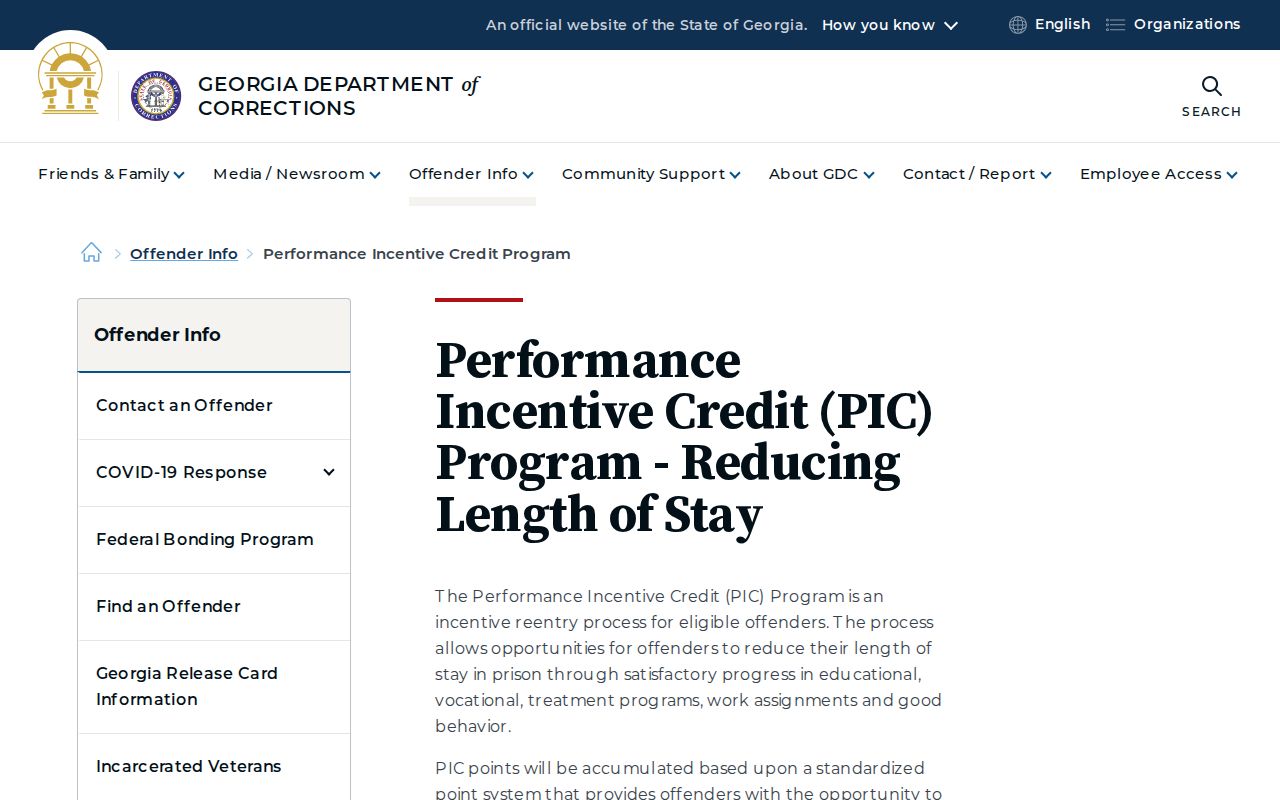
The live GDC page should be checked for current eligibility details before connecting a credit to any named sentence.
Forsyth Serious-Felony Release Rules
O.C.G.A. 17-10-6.1 is the key caution for covered serious violent felony sentences. Non-life terms in the covered category, for offenses within the statute's date rules, are not parole eligible and must be served as imposed. This is often described as a 100 percent-service rule, not an 85 percent rule.
The Parole Board also identifies non-life serious violent felony sentences, certain recidivists, and life without parole among categories that are not parole eligible. A charge name alone is not enough to perform the analysis. Read the conviction, offense date, sentence, and any amended order.
Forsyth Tentative Parole Month
A Tentative Parole Month is the month when the Georgia Parole Board expects to complete final review and may set a parole release date. It is not a final date. The Board can deny parole, revise the month, delay release after conduct or unmet conditions, or reconsider before departure.
Search the TPM lookup with a GDC ID, inmate number, or available personal data. Then compare the result with the GDC maximum date and current status. After release, use GDC actual release and Parolee Search to determine whether the person left prison under supervision.
The Board's TPM lookup screen is shown below as the distinct offender-specific source.
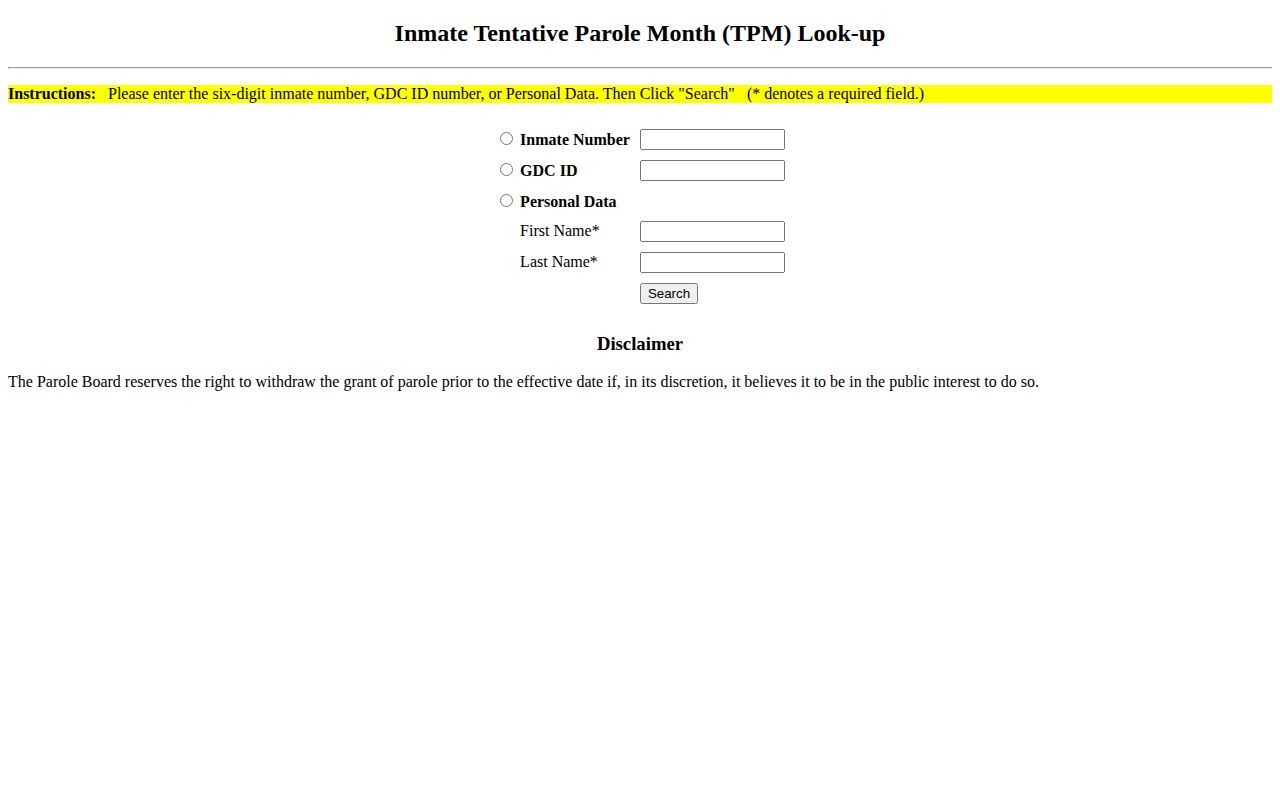
The lookup provides parole-review context, while GDC remains the source for the state custody and actual-release fields.
Forsyth Release Dates by Custody
A date from one system cannot be carried into another. Forsyth County Jail records describe county custody. GDC records describe state corrections custody. The Bureau of Prisons locator covers sentenced federal prisoners, while the ICE locator addresses immigration detention. A county entry that records a transfer may be the end of the county stay but not the end of confinement.
For a federal sentence, the BOP locator may show a release date and no facility when that date is in the past. BOP explains that this combination can mean the person is no longer in BOP custody. U.S. Marshals pretrial detention has no matching broad public release locator, so the federal court docket and known contract facility are more useful. ICE custody requires the ICE Online Detainee Locator System.
A state parole date also answers a narrower question than complete freedom from legal control. The person may leave GDC and begin parole with DCS. Likewise, a county jail release can lead to probation set by a Forsyth court. Compare the release event with the supervision record before treating the sentence as fully discharged.
When sources conflict, record the label and agency exactly. Ask whether a date is expected, maximum, tentative, actual, or the end of supervision. That simple distinction prevents a future estimate from being reported as an event that already occurred.